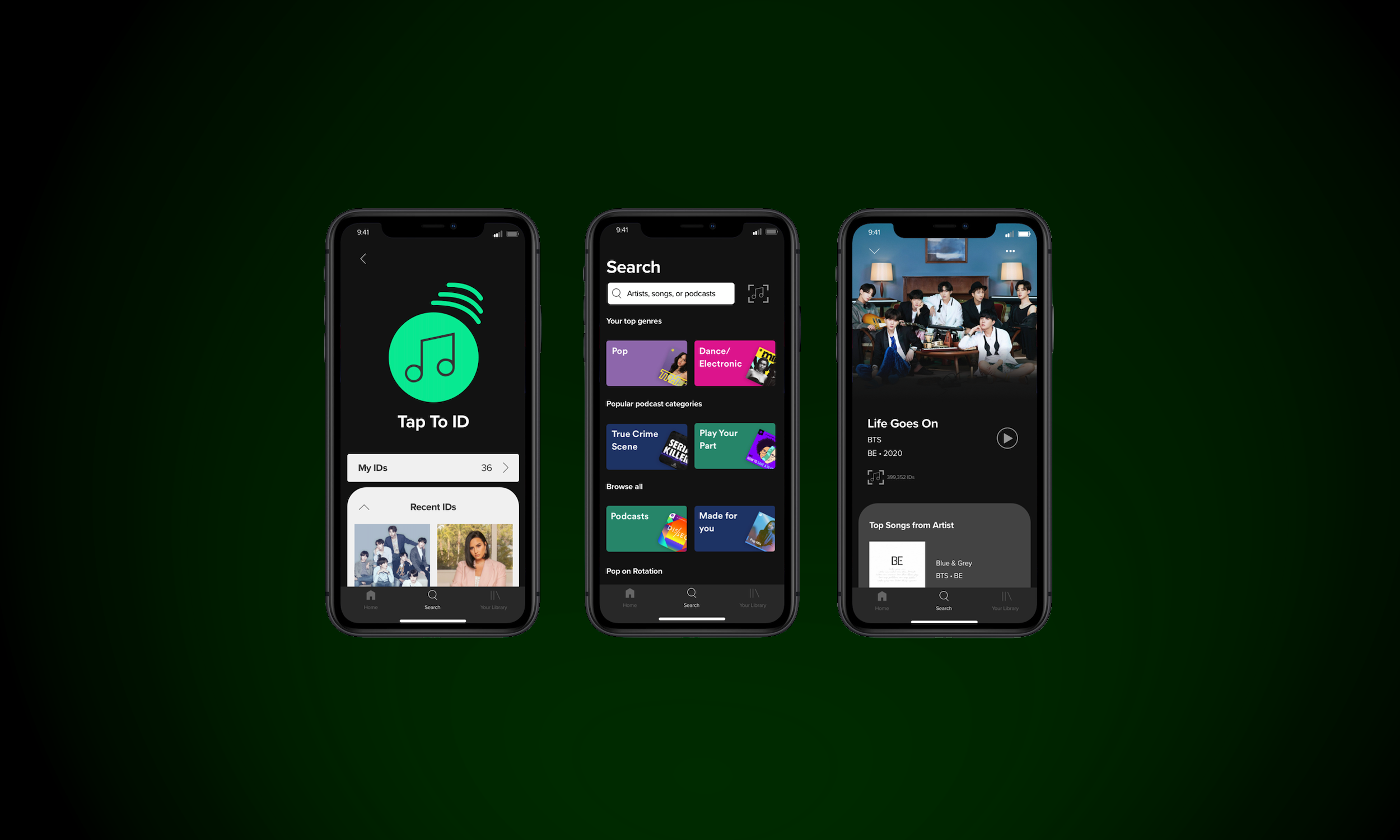
Seamless music discovery, built into everyday listening
Role
UX / UI Design (personal project)
Year
2020
Responsibilities
Market and user research, Interaction design, Wireframing, User testing
Spotify’s mission is clear: “to help people listen to whatever music they want, whenever they want, wherever they want”—all in a completely legal and accessible way. As a leading streaming platform, Spotify aims to maintain that position by continuously improving user engagement and retention.
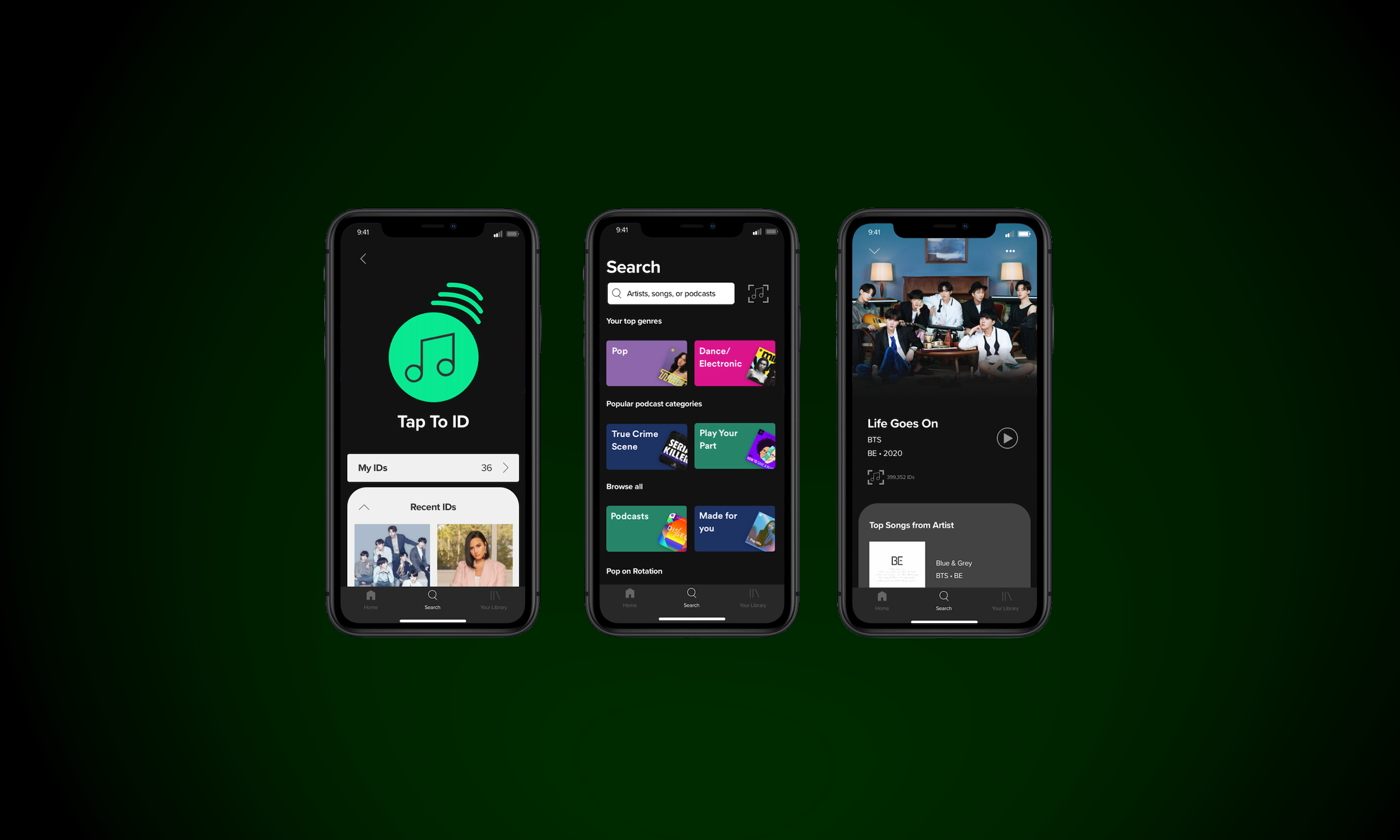
To support this goal, Spotify has the opportunity to integrate features that users have been requesting for years. This project explores how a built-in music recognition feature could enhance the listening experience by allowing users to identify songs seamlessly within the app. Through research and concept development, this solution demonstrates how Spotify can evolve its ecosystem while reducing reliance on third-party tools.
The process
Discovery
Understanding the problem space
Analyzing attitudes and behaviors around music discovery
User Research
Digging deeper into user behaviors
Conducting interviews to identify key themes, pains, strengths
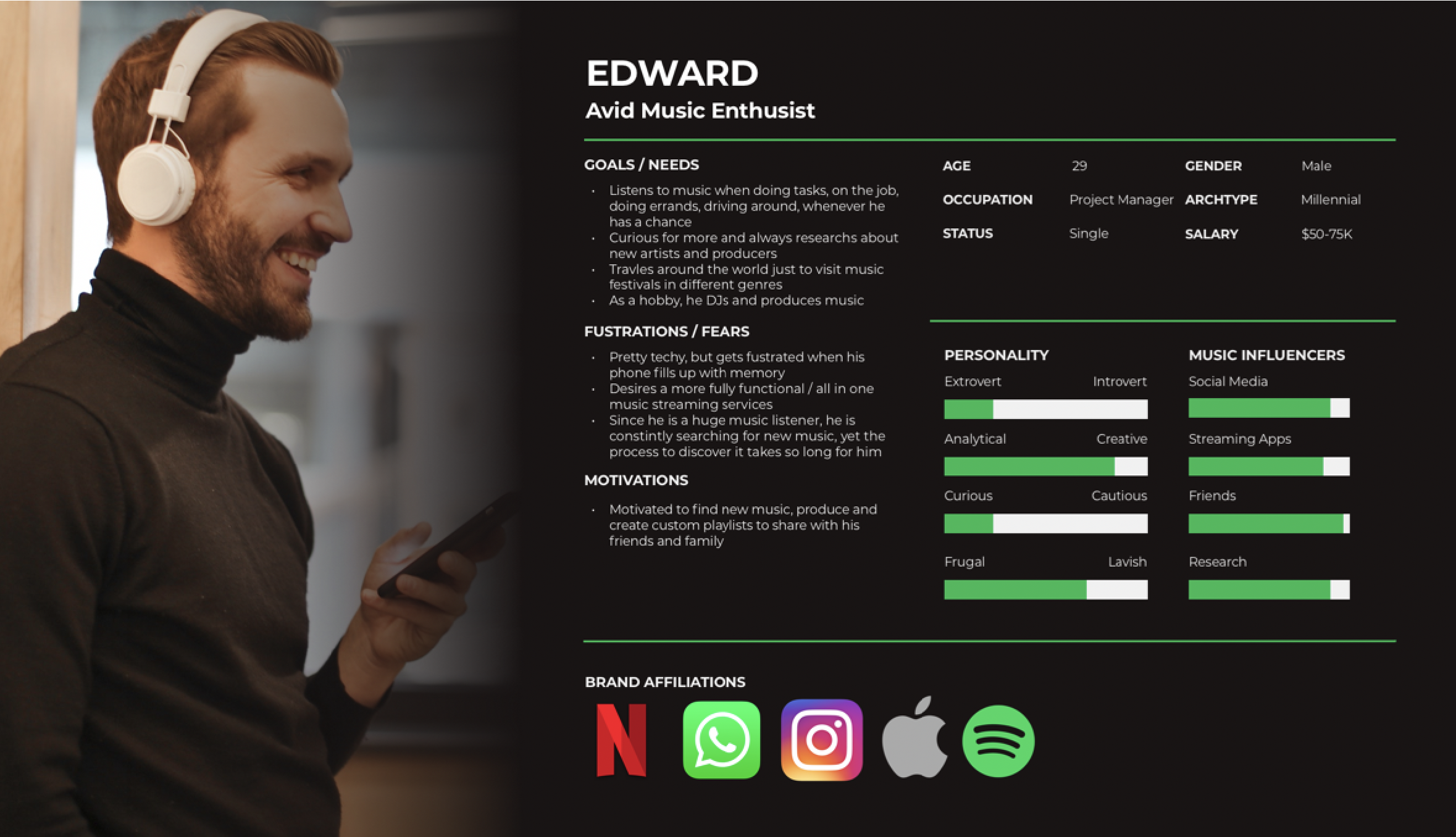
Defining users and their needs
Interaction Strategy
Rapid iteration and storyboarding
Building out prototypes for Spotify ID
Narrowing the focus
Visual Design & Testing
Applying the design system
Low fidelity testing
Testing and re-iteration to improve feature
Discovery
Framing the problem space
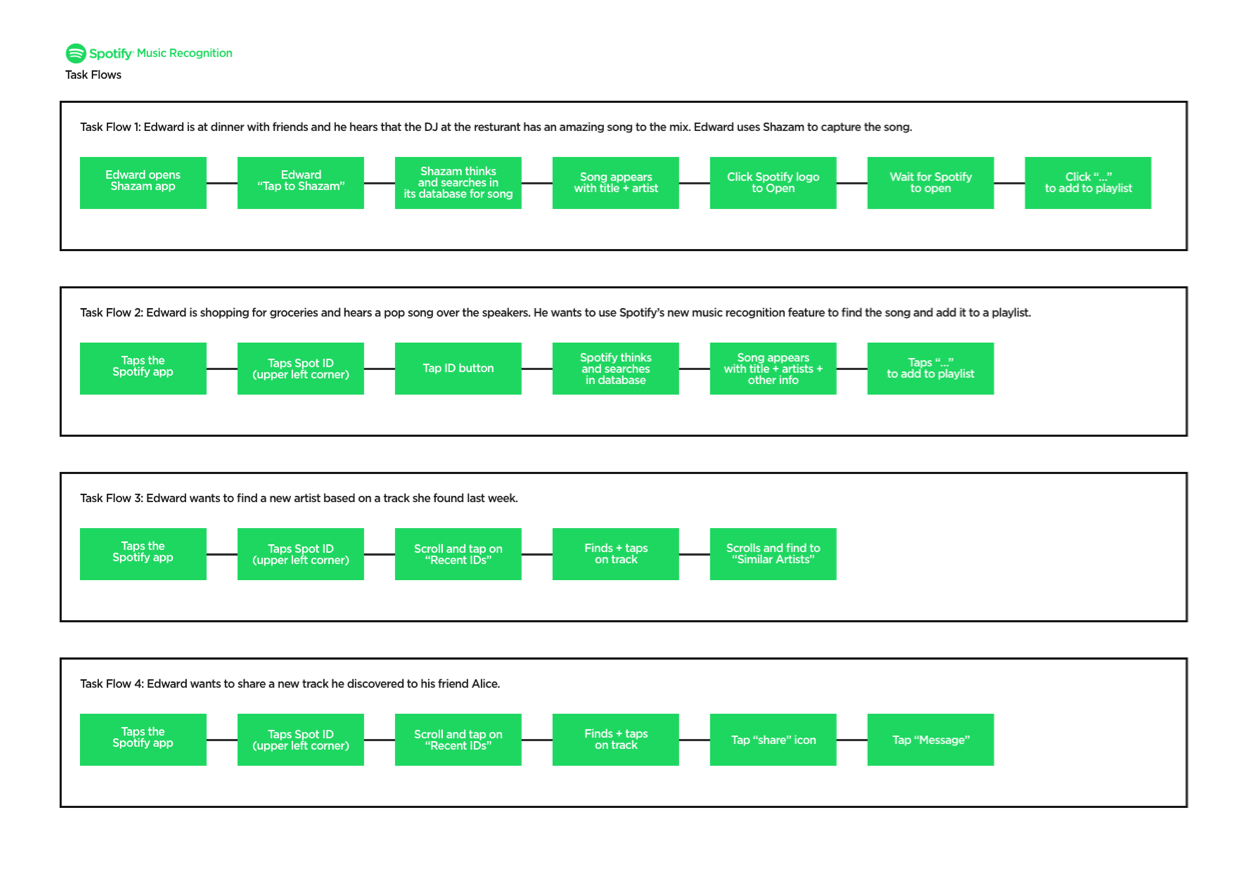
Imagine you’re in a café and hear a song you love, but you have no way to identify the artist or track. To solve this, you open your phone, launch Shazam, and within seconds receive the information you need.
While effective, this process requires switching between multiple apps. If Spotify offered built-in song recognition capabilities, users could identify and engage with music directly within the platform—eliminating friction and creating a more seamless experience.
What are the user’s general attitudes and behaviors around discovering music?
What makes people want to discover new music? What are some obstacles they face?
What are the most common ways people find new music, and why do they use those methods?
Who are the types of people who like to discover new music?
What are problems that people encounter when listening and researching for new music?
Analyzing user attitudes and behaviors around music discovery
After doing a deep dive of interviews, here are some insights I’ve gathered:
The majority (87.9%) of users like to listen to music in the car while driving
A lot of users like to keep up with music trends
The interesting takeaway is that 63.6% of users have Shazam, yet only 31.3% of them actually use the feature
Some of the ways users discover new songs/artists is by Spotify curating it for them and by word of mouth
One of the open-ended questions was what feature they would like to add to Spotify—answers included showing lyrics and a more expanded search option
Majority of users listen to music based on the mood they are in or want to be in
Some surprising takeaways:
Users would love more behind-the-scenes content of the artists and songs
90.6% of users are willing to buy a membership for a music streaming service
User research
Exploring user behaviors and discovery patterns
Although Spotify is a globally recognized platform, users still rely on multiple tools to fully support their music discovery experience. To better understand this behavior, I conducted in-depth user research, including one-on-one interviews, to identify pain points, patterns, and opportunities for improvement.
Spotify background and statistics
There were 286 million monthly active users of Spotify according to the company’s Q1 2020 report. Of these, 130 million were Spotify Premium subscribers.
A 69 million increase in users (32%), and a 30 million increase in subscribers (30%)—a growth rate that has been fairly consistent in recent years. Spotify remains comfortably in the lead with 108 million subscribers to Apple Music’s 60 million, as of June 2019. Spotify increased subscribers to 130 million in Q1 2020, while Apple Music is estimated to be somewhere near the 70 million mark as of February 2020.
Spotify claims a 35% market share, leading Apple Music (19%), Amazon Music (15%), and YouTube at 6%. Spotify is the most popular channel with under-30s, with only US-specific Pandora coming close.
Largest age bracket: 25–34 (29%)
Second age bracket: 18–24 (26%)
Third age bracket: 55+ (19%)
Spotify is the most male-dominated platform.
Defining core user needs and use cases
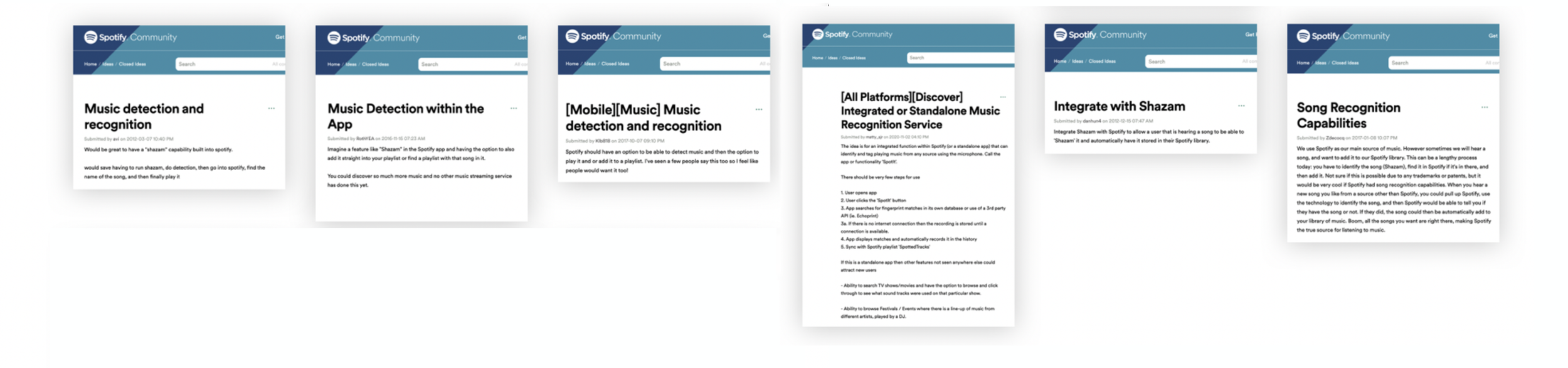
Direct competitors

Strengths
Highly intuitive and user-friendly interface
Extensive catalog with strong cross-platform compatibility
Industry-leading recommendation algorithm
Personalized playlists driven by user behavior and preferences
Social features that support collaboration and sharing
Student pricing accessibility
Seamless experience across desktop, tablet, mobile, and Apple TV
Robust and widely adopted free tier
Weaknesses
Limited functionality within the free tier
Ad interruptions impact the listening experience
Restricted control over playback in the free version
Limited visibility and discoverability of friends/users

Strengths
Strong integration for users with existing music libraries
24/7 human-curated global radio
Lyric-based search functionality
Seamless syncing across Apple devices
Broad and diverse radio offerings
Native access to song lyrics
Weaknesses
Interface can feel dense and overly segmented
Limited social and sharing capabilities
No collaborative playlist functionality
Reduced compatibility outside the Apple ecosystem
Inconsistent music curation experience
No free tier offering
Weaker recommendation engine
Desktop experience lacks optimization; mobile performs better

Strengths
High-fidelity audio streaming
Rich video content, including exclusive livestreams
Strong positioning around emerging and underrepresented artists
Artist-first platform with direct value to creators
Weaknesses
Heavily skewed toward specific music audiences and trends
No free tier
Smaller catalog relative to competitors
Slower load and buffering performance

Strengths
Highly engaged and active creator community
Enables uploading of original content and remixes
Strong platform for discovering emerging artists
Weaknesses
Less comprehensive catalog
Simpler, less sophisticated search and recommendation system
Limited personalization for track discovery
Indirect competitors

Strengths
Clean, frictionless user interface
Auto Shazam enables continuous song recognition
Unlocks additional content through camera-based interactions
Fast and accessible music discovery
Integrates with Spotify, YouTube, Amazon Music, and more
Ability to immediately stream identified tracks and videos
Weaknesses
Cannot identify songs through humming or singing
Limited feature depth beyond recognition
Integration with external platforms can be inconsistent
Performance dependent on network reliability
Spotify has expanded its search functionality beyond artist and track names to include lyric-based discovery. Building on this foundation, integrating a native microphone feature would enable a more intuitive and immediate form of music recognition. Users could identify songs not only by listening, but also by humming or singing—directly within the Spotify ecosystem.
While similar functionality exists through Shazam, the current experience introduces friction by requiring users to switch between platforms. This includes downloading a separate app, creating an account, and linking services. Spotify is uniquely positioned to consolidate this experience into a seamless, in-app solution.
Lyric-based interaction presents a strong opportunity for deeper engagement. Users increasingly value context and storytelling within music, and integrating this into the recognition experience would elevate both discovery and retention.
Key takeaways
Design a native music recognition feature within Spotify that includes:
A clean, intuitive, and low-friction interface
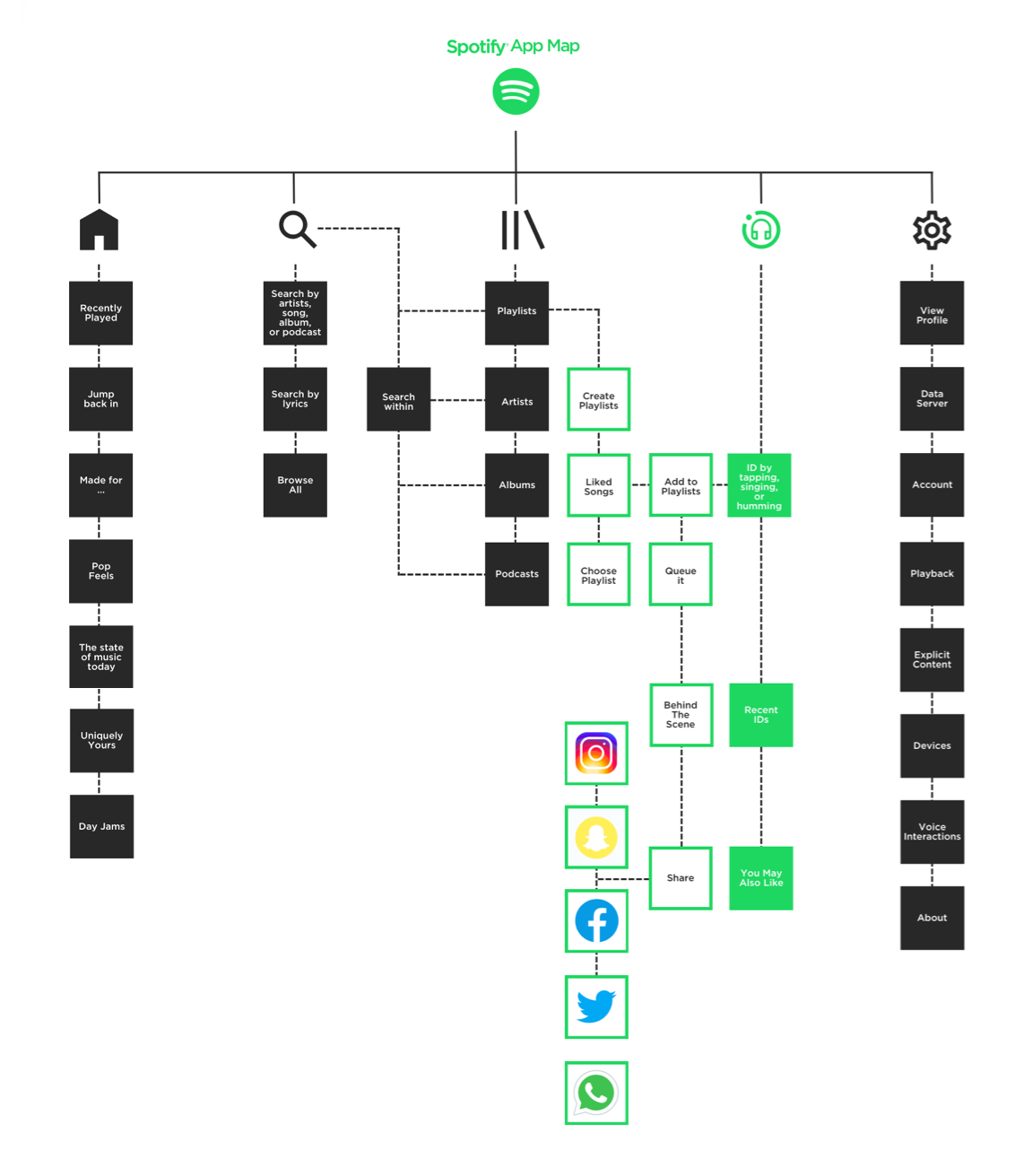
Deep integration within Spotify’s existing ecosystem
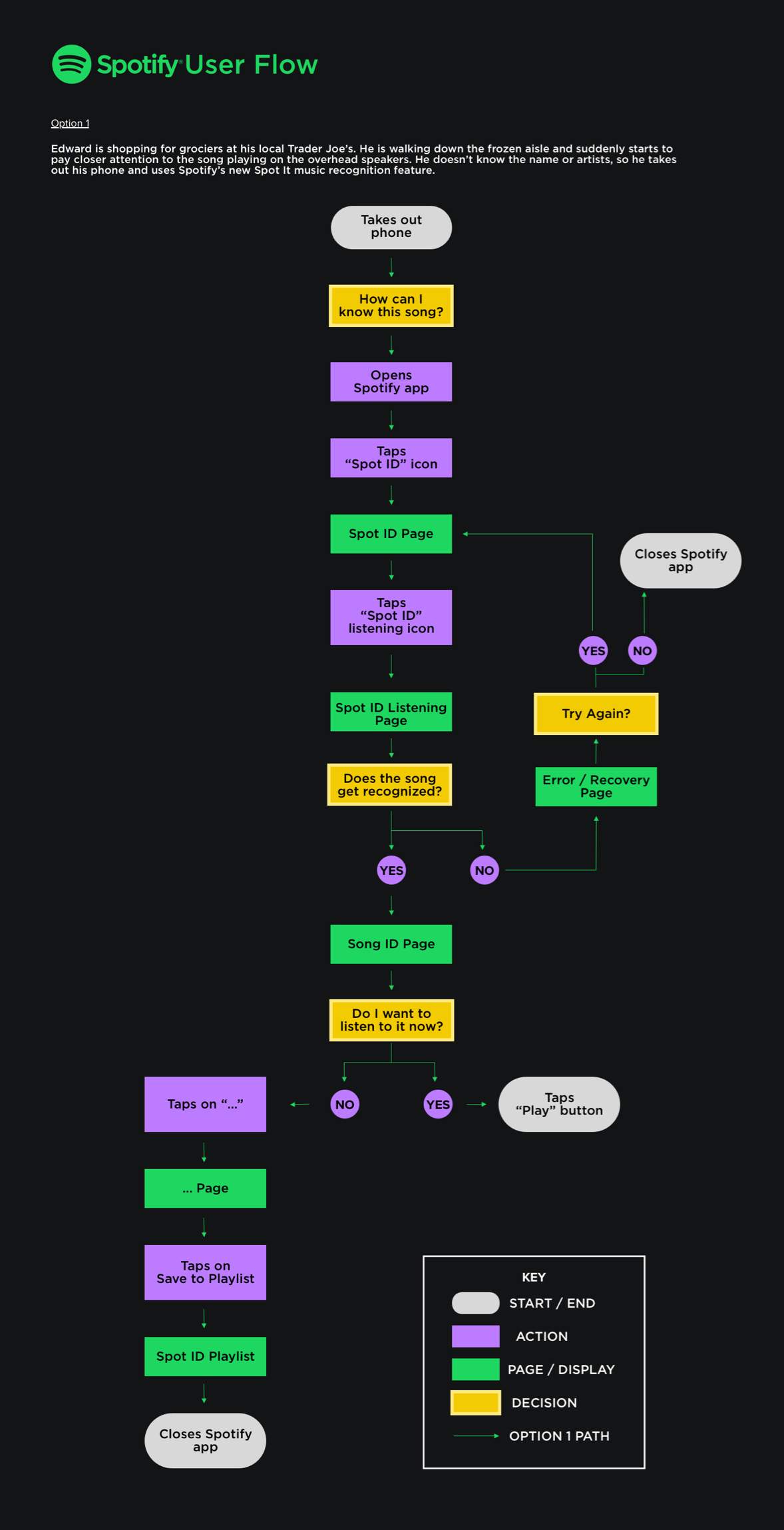
Multiple input methods: listening, humming, singing, or typing lyrics
Real-time recognition across a variety of environments
Seamless ability to save, queue, and add tracks to playlists
Native sharing across social platforms and between users
Expanded metadata, including lyrics, credits, genre, and related content
Opportunities
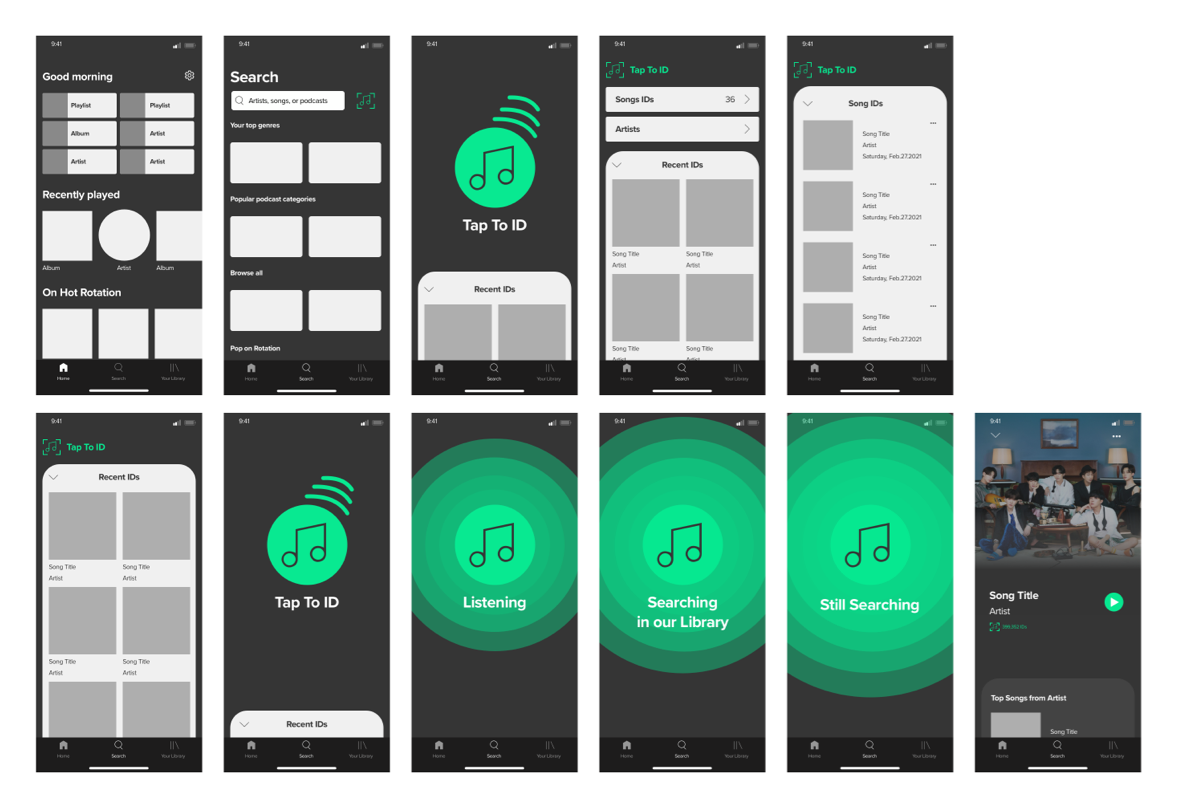
Lo-fi Wireframes
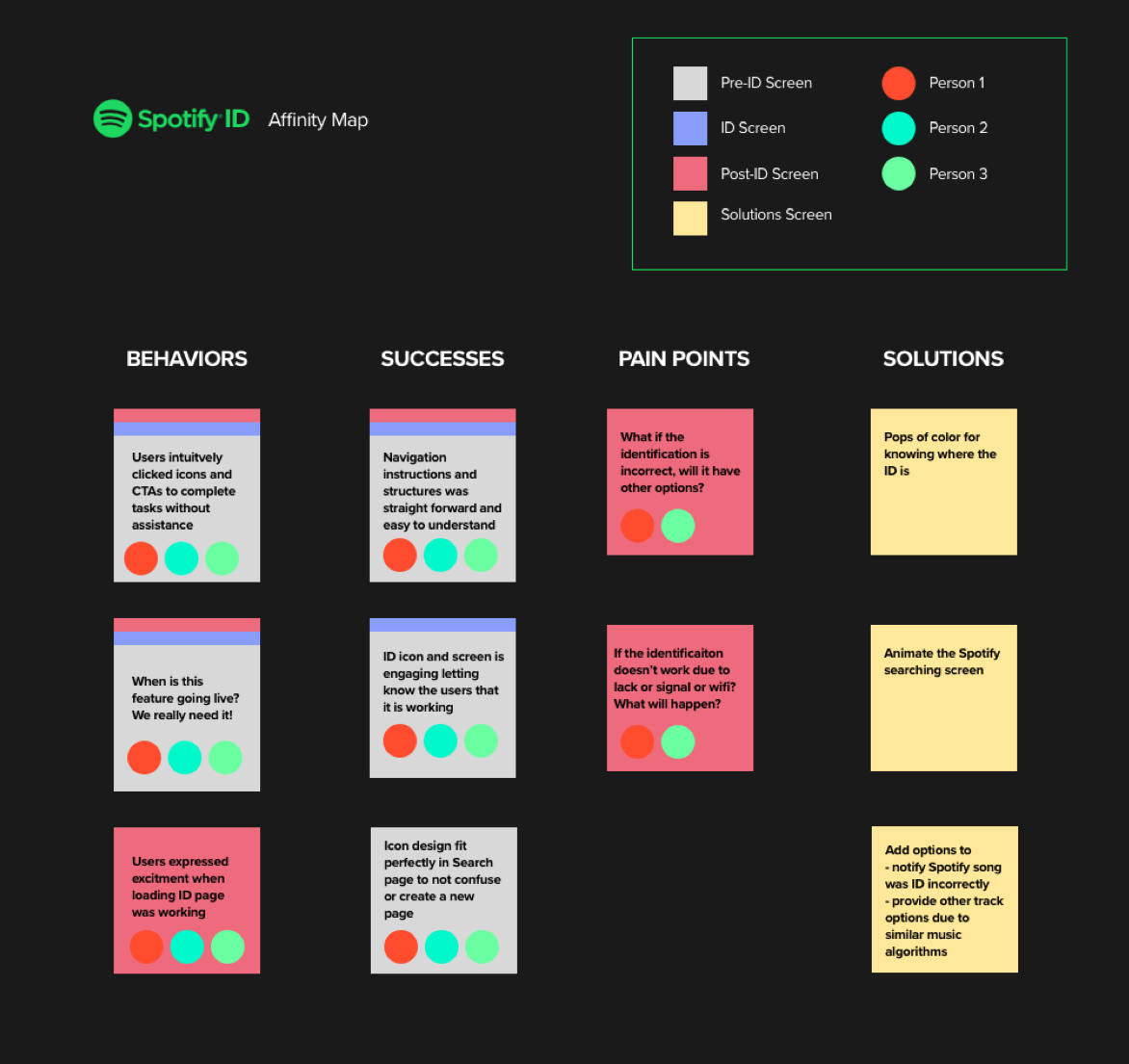
Users found the feature intuitive and easy to navigate without assistance. The integration of Spotify ID made music discovery more seamless and accessible within the app.
Users also responded positively to the listening functionality, noting that it enhanced their ability to discover and engage with new music more efficiently.
Visual design and testing